
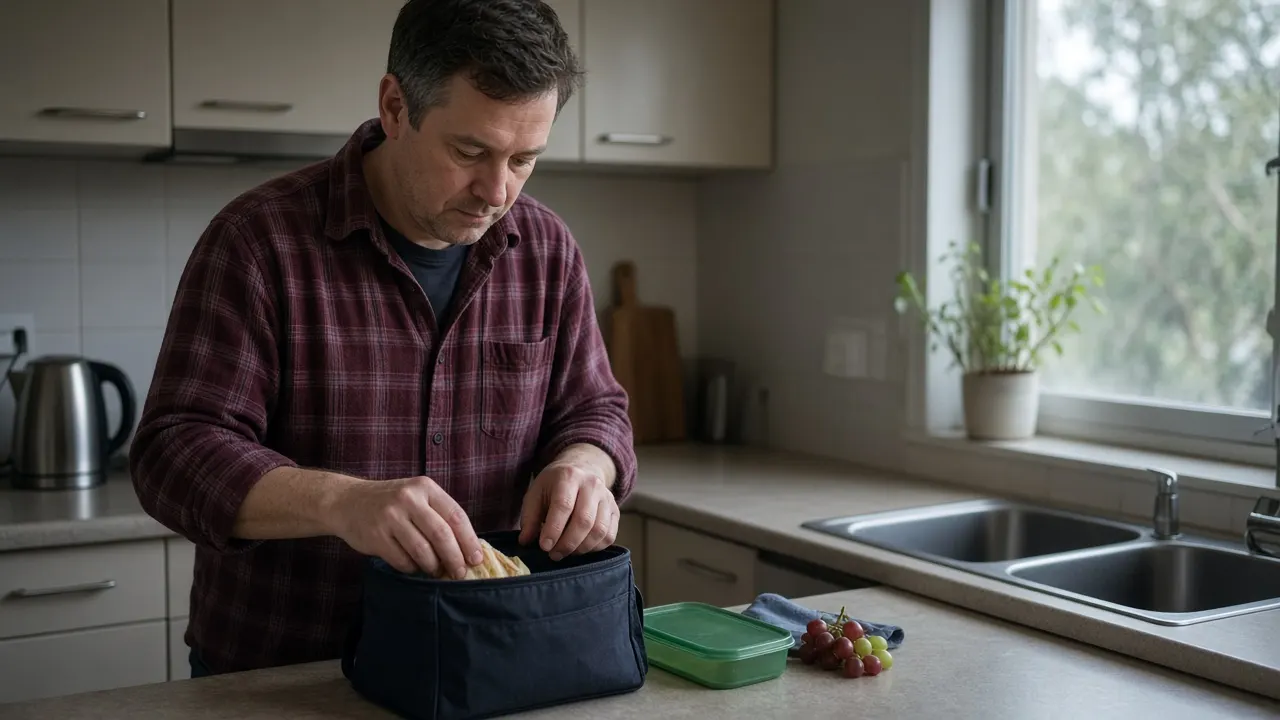
Some weeks do not need a better attitude. They need you to stop adding things.
A deadline moves forward. A child is off colour. A parent needs a call. The money is tighter than you thought on Sunday. By Wednesday you are either grinding until you are short with everyone, or you drop the lot and call it a write-off.
There is a middle. You stay decent, you sleep, you eat, and you keep the one promise that other people are already counting on. The rest can wait.
Name what is actually heavy
Before you reorganise your life, write one line. What is the load this week?
- Work that will not fit in the hours you have.
- A person who needs you.
- Money.
- Your own body — poor sleep, pain, or a run of nights.
If you cannot name it, every irritation feels the same size. The email and the sick child get the same panic. They are not the same.
Once it is named, you can see what is yours to do today and what is only noise.
The few things you still do
On a heavy week, do not invent a new routine. Keep three things.
Sleep. The Sleep Health Foundation says most adults need about seven to nine hours. That is general guidance, not a personal prescription. Being in bed is not the same as being asleep.
A workable version: pick a lights-out time you can actually keep, and protect it three nights this week. If you are in bed at 10:30pm and the alarm is 6:00am, that is seven and a half hours available. You may not sleep all of it. You have still given the night a chance. Do not “catch up” by staying up to finish one more task that can wait until morning.
One proper meal. Not a perfect diet. One meal you sit down for, with food that would still look like a meal if someone else saw the plate. The other meals can be plain. Hunger plus a hard week is how small problems become sharp words.
The promise you already made. Pickup. The call. The draft you said you would send. If you can only keep one agreement this week, keep the one another person has planned around. For how to say so early when you cannot, Keep Your Word is the longer piece. For the twenty minutes after you walk in, Come Home On Purpose still applies. A heavy week is not a reason to disappear into the phone.
Training, if it happens, stays small. Train On The Weeks You Are Already Tired is the short version. Do not add it on a night when you are too tired to drive or to trust your balance.
When even that is too much
Illness, a night shift, or a real crisis can remove the three things. Say so, in one sentence, to the person who needs to know.
Then keep the smallest version:
- Sleep when you safely can. Do not drive wrecked.
- Eat something real once, even if it is late.
- Tell the person waiting what you can still do, and what you cannot.
That is not quitting. It is how you are still useful tomorrow.
If the heaviness is not the week but a low mood that will not lift, or thoughts of harming yourself, this article is the wrong help. In Australia, Lifeline is 13 11 14, at any hour.


An illustrative week
Assume a man who finishes at 6pm, has school pickup on Monday, Wednesday, and Friday, and has a report that grew by two days of work. He does not add a 5am session to prove he can cope.
Monday, Wednesday, Friday: he leaves on time for pickup. Those three afternoons are the promise. Tuesday and Thursday he stays back one hour, not three, and he writes down what is still unfinished so it is not living in his head at dinner.
Lights out is 10:30pm on Sunday, Monday, and Tuesday. That is three nights with seven and a half hours available, not a claim he slept all of it. Thursday he is up late because the child is unwell. He does not punish Friday with a double workload. He sends a short note in the morning: the report will be Monday, and here is what is already done.
He eats a proper dinner on the three pickup nights, because he is home. The other nights are simpler food, still sitting down for ten minutes.
Checked simply: three protected nights, three kept pickups, one delayed report told early. The week is still heavy. He is still someone the house can rely on.
Leave these alone
Do not start a new program on Wednesday night because you feel behind.
Do not skip sleep to look committed. You will be shorter with people on Thursday, and you will call it their fault.
Do not make the whole household carry a mood you have not named. One sentence is enough. “This week is heavy. I am still doing pickup.”
Keep this
Name the load in one line.
Protect sleep on the nights you can, eat one proper meal, and keep the promise someone else is counting on.
If the week takes even that, say what you can still do. Do not add a speech on top.
For the wider domain, see Resilience.