
A full program is easy to respect and easy to abandon. The week fills up, the session needs an hour you do not have, and training becomes another thing you will restart on Monday.
This is the smaller version. It assumes you already have a job, a household, and a body that is not twenty-two. It will not turn a crowded month into a new physique. It keeps a strength habit alive so the next clearer week has something to build on.
What the public guidance actually says
Australia’s physical activity guidelines ask adults for moderate to vigorous activity for 30 minutes or more on most days, plus muscle-strengthening work on 2 or more days. That page is general public guidance. It is not a diagnosis, and it is not a program written for your joints.
Five days at 30 minutes is 150 minutes. That is one plain reading of “most days.” The sessions below are a floor for a crowded week. They are not a claim that you have met that guideline.
Checked arithmetic, so the gap stays visible:
- Three strength sessions of 20 minutes is 60 minutes. That is strength work, not 30 minutes of activity on most days.
- If you also walk briskly for 20 minutes on two other days, that is another 40 minutes. 60 + 40 = 100. Still short of five days at 30 minutes.
- Two sessions of 20 minutes, the ugly-week version, is 40 minutes of strength. Useful. Not the full guideline.
Say that to yourself before you turn a short week into a story about failure. Short of the guideline and still training is a different fact from doing nothing and calling it a plan.
If you are returning after an injury, illness, or a medical restriction, this article is the wrong starting point. Get advice from a qualified clinician. A general rebuild story such as The Comeback is not treatment.
The ordinary week: three times, twenty minutes
Pick three days you can actually protect. Not the ideal days. The ones that survive school pickup, a late shift, or a meeting that runs long.
Each session is the same five movements. No gym is required. A backpack with books, two shopping bags with water bottles, or your own body weight is enough.
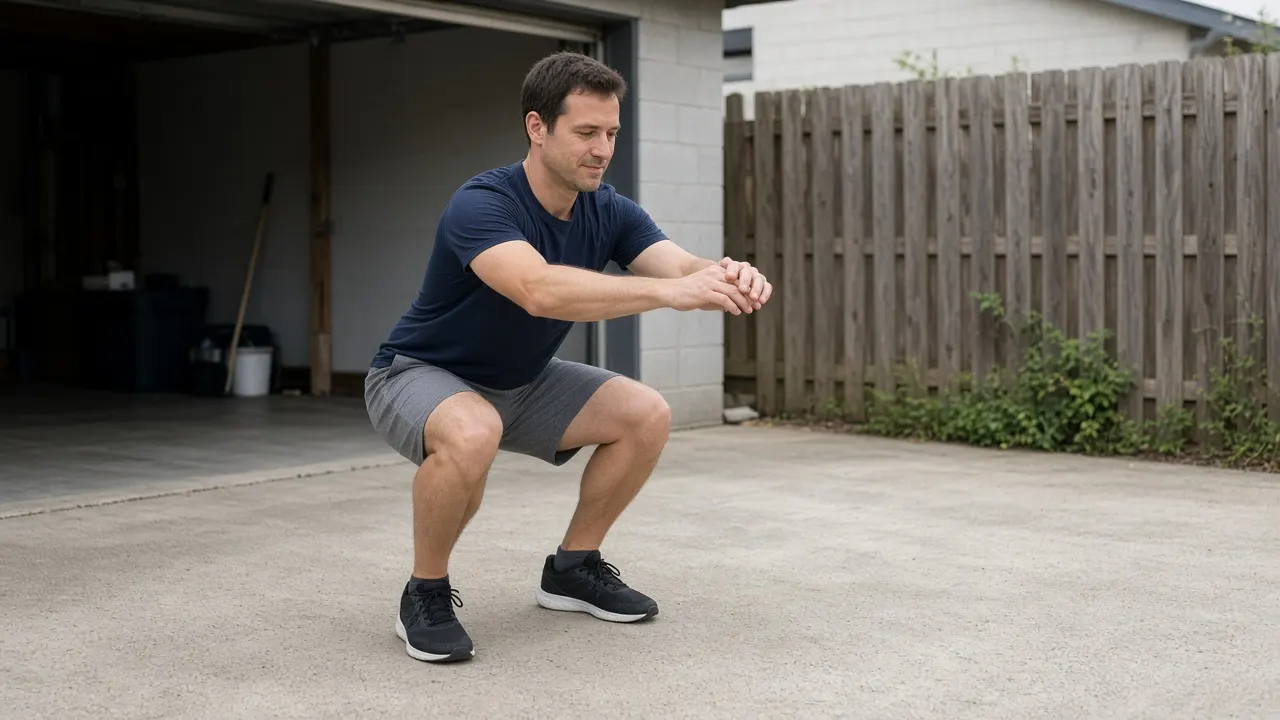
- Sit to stand, or a squat you can stand back up from. 3 sets of 8. If your knees complain in a way that is pain rather than effort, shorten the range or use a chair.
- Push. Push-ups on the floor, a bench, or a wall. 3 sets of 6 to 10. Stop a rep early rather than collapsing into the floor.
- Hinge. A backpack deadlift, or a hip hinge holding the bag in front of you. 3 sets of 8. Keep the bag close. If your back pinches, stop.
- Carry. Walk with a bag in each hand for 30 to 40 steps, then swap your grip and walk back. Two trips.
- Breathe and walk. Two easy minutes. You are finished.
A 20-minute session is the container, not a dare to add more. If you finish in 16 because the rest breaks were short, leave it. If you need 25 because you were interrupted, that still counts.
Rest long enough that the next set is clean. You are not trying to see how hard you can go.
For an even leaner strength menu on days when the clock is the whole problem, Strength Without Extra Time sits beside this one.
The ugly week: one short session, then a walk
Some weeks the roster, illness, or caring load removes the three sessions. That is a full week, not a verdict on you.
The shorter option:
- One 12-minute session: one set of each movement above, then stop.
- On one other day, a 15-minute walk outside if you can do it safely.
- Leave the other days alone. Sleep and the work you already owe people come first.
If you are too tired to drive, lift, or trust your balance, you do not train. Fatigue and heavy machinery, or a long drive home after nights, are a safety question before they are a discipline question.
Pain that is sharp, one-sided, or still there the next morning is a reason to stop and get it checked. Ordinary effort is not the same thing. You should be able to speak in short sentences between sets.


An illustrative week
Assume a man who finishes work at 5:30pm, has children in the house three nights, and can use the garage for a quarter of an hour. Monday and Thursday after the kids are in bed: the 20-minute session. Saturday morning before the sport run: the third session. Tuesday he is on late shift, so that day is a write-off, not a debt. Wednesday he walks to the station instead of sitting in the car queue — about 18 minutes of easy walking, counted once, not invented into an hour.
That week is roughly 60 minutes of strength and one short walk. It does not meet 30 minutes on most days. It is a week he can repeat. A plan he will not repeat is not a stronger plan.
If Saturday disappears because of a family thing, he keeps Monday and Thursday and does not “make up” Sunday night by stacking two sessions back to back when he is already sore.
What to skip
Do not buy a new program because this one feels too plain. Plain is the point.
Do not train through chest pain, dizziness, or a joint that is swelling. That is not toughness.
Do not compare a 20-minute garage session with a photograph of someone else’s year in a gym. The comparison does not move the bag.
Keep this
Put two or three sessions on the days that already exist.
Do the five movements. Stop while the reps are still clean.
If the week collapses, do one short session and one walk, and do not call the rest of the week a failure.
The public guideline is still the longer aim. This is how you stay in the work until you have the minutes for it.
For the wider domain, see Health & Strength.