

The drive home is often the last quiet stretch of the day. Then the door opens and you are still at work in your head.
The people inside do not need a speech about how hard it was. They need you in the room, for a little while, before the night turns into chores, screens, and everyone talking past each other.
This is a small arrival. Twenty minutes. One person. The phone out of your hand.
Leave the day at the door
You do not need a ceremony. You need a line between the job and the house.
Before you walk into the conversation, take two minutes:
- Put the keys and the bag down.
- Take off the work layer if you can — boots, hi-vis, the jacket that still smells like the site.
- Put the phone in another room, or face-down in a pocket you will not check.
If the day was ugly, say one sentence to yourself: the problem can wait until after this. You are not pretending it vanished. You are refusing to make the household carry it in the first minutes.
If you work from home, the line is still real. Close the laptop. Leave the room you worked in. Come back in as the person who lives there.
The first twenty minutes
Pick one person who is actually there. A partner. A child. A parent you live with. A housemate, if that is the household you have.
Join something they are already doing. Do not open with a review of their day, and do not open with yours.
Useful:
- Sit at the bench while dinner is underway and take one job without being asked.
- Watch the last few minutes of what your child is showing you, then ask one question about it.
- Walk the dog with your partner and let the first part of the walk be theirs.
Less useful:
- “How was your day?” asked while you are still reading a message.
- A full debrief of your meeting before anyone has eaten.
- Buying something on the way home and calling that presence.
Twenty minutes is long enough to be felt. It is short enough to survive a school night.
If you want a wider look at how you show up in each role, Am I a Good Man? is the slower check. This piece is only the arrival.
When the house is already loud
Some nights the twenty minutes will not happen in a straight line. A child is overtired. Dinner is late. You walked in already sharp.
Use the shorter version:
- Ten minutes with one person.
- One task you finish in front of them — packed lunch, a bath, the bins — so presence is visible.
- Then say, out loud, what the rest of the night is. “I need twenty minutes to eat, then I can help with homework.”
If you are the one who has been home all day, you do not automatically get the quiet first. Ask who needs the first ten minutes, and take the other end of the night if that is the fair swap.
Fatigue is not a character flaw. You do not have to walk in and perform a perfect family scene. You do have to stay out of the phone and actually be there.
When you have promised to be the one who handles pickup, bedtime, or the shop, treat that promise the way you would treat a work commitment. Keep Your Word is the longer piece on that.
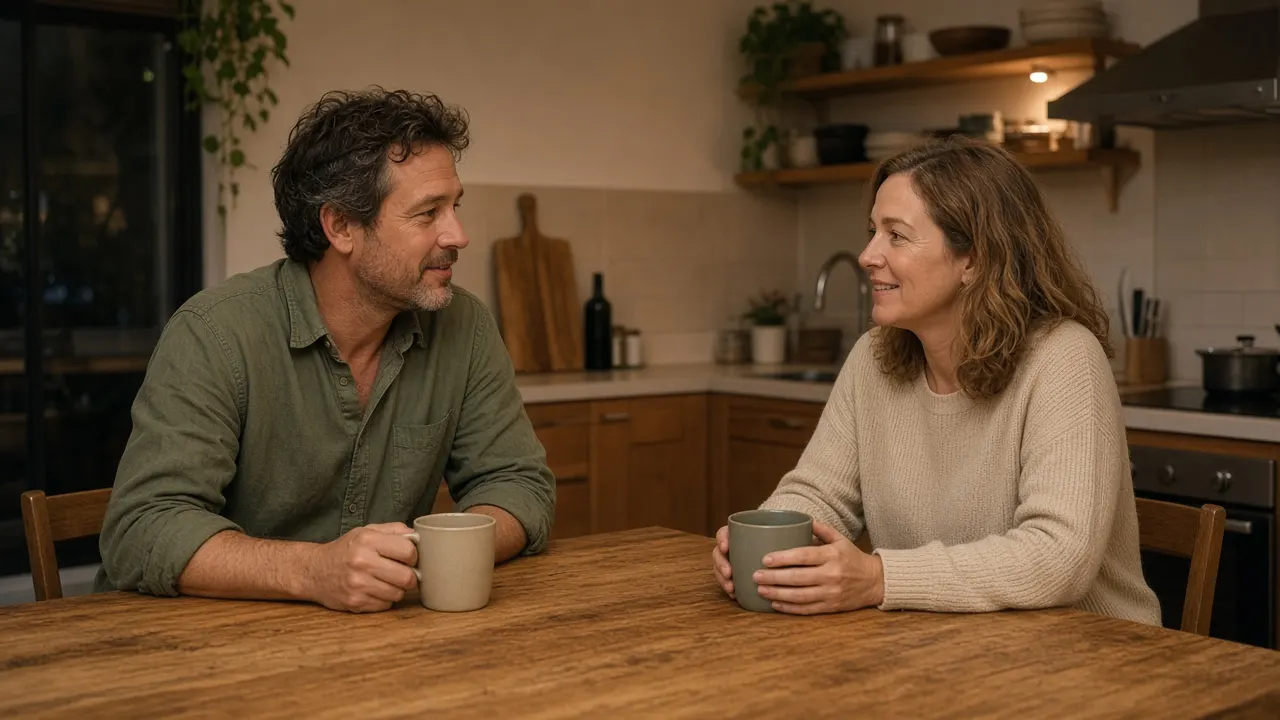

Examples, so the shape is clear
These are illustrations, not a script you owe anyone.
Shift finish. You walk in at 7:40pm. Your partner has already fed the kids. You wash your hands, leave the phone on the fridge, and sit with the younger one for the last part of the bath. You do not recount the shift until the children are down. Assumption: someone else covered the meal. If that is not true, the first twenty minutes might be the meal itself, cooked or unpacked together.
Teenager. Your son is on the couch with a game. You sit for one round, or for the time it takes to finish a cup of tea, and you do not comment on the screen unless he asks. The point is that you stayed. Assumption: he still tolerates you in the room. If he does not, a lifted chin and “I’m home” plus a later offer — “I’ll be in the kitchen if you want food” — is enough for that night.
Two tired adults. You both worked. Nobody is the welcoming committee. You split the first half hour: one person starts food, the other sits with the child, then you swap. The debrief waits until someone has eaten.
What to skip
Do not interrogate. “Did you do your reading? Did you text your mother back? Why is this mess here?” can be a fair conversation later. It is a poor hello.
Do not make a child manage your mood. If you need ten minutes alone before you can be decent, say that. “I need ten minutes, then I am yours.” Then come back when you said you would.
Do not turn a hard day into a speech about how little anyone appreciates you. If something at home needs to change, pick a calm time and one specific ask.
Keep this
Before you walk in, put the phone away.
Give the first twenty minutes to one person who is there. If the night is already breaking, make it ten, and say what the rest of the evening will be.
The arrival is the practice. The rest of the night can be ordinary.
For the wider domain, see Bonds & Connections.